
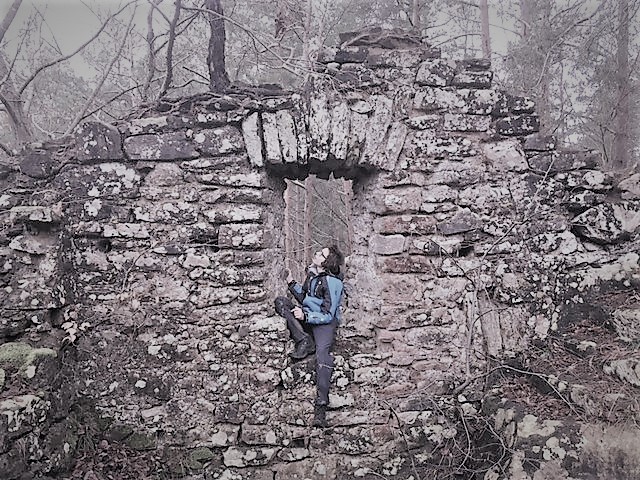
In the hushed midwinter gloom, only three sounds rung out in the Haupeschbach valley: our hiking boots squelching on the muddy path, the incessant murmuring of the snowmelt-swollen stream, and a mysteriously distant woodpecker, which never seemed to get any closer before its ghostly rattle vanished completely into the frigid air.
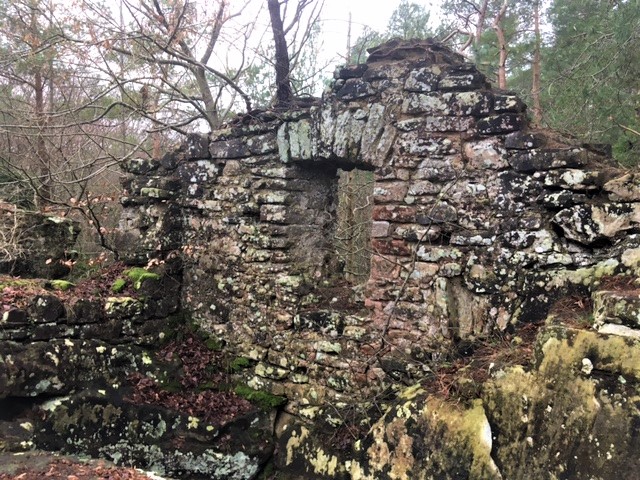
The last day of the school holidays, and a long hike was just what we needed – a broad loop taking in the Heringerbuerg (or Heringerburg), a dramatic hidden ruin deep in the Mullerthal forest. The castle was first mentioned in a document of 1393, but is almost certainly quite a bit older than that. In October 2020 it was given the (rather overdue…) honour of being proposed as a national monument of Luxembourg.
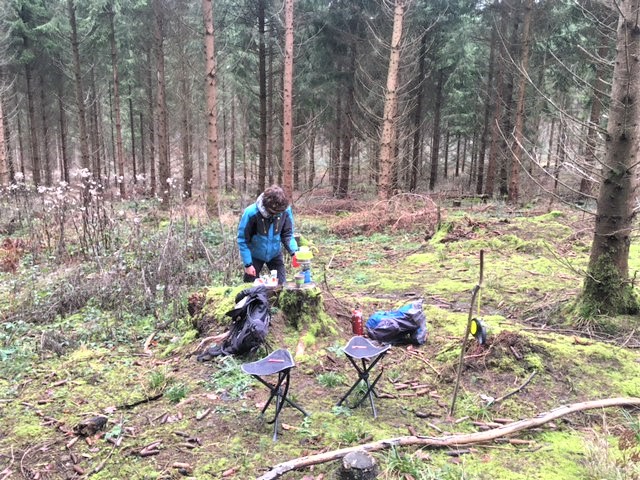
This area is known for being popular with tourists, but on a day like today – dark, off-season, off the main paths – we had it all to ourselves, not meeting a single hardy soul on our 19km trek.
This gave us plenty of time to remind ourselves of the curious legend of Griselinde that surrounds the Heringerbuerg castle, a tragic tale that goes something like this:
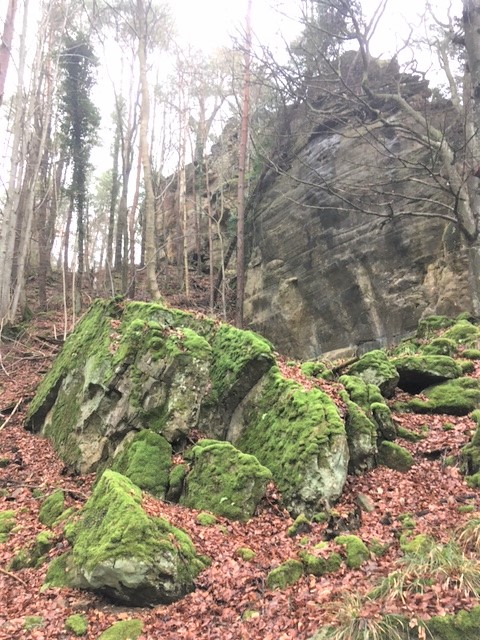
They said that Griselinde had a voice gifted to her by the angels themselves. But she also had a terrible power: those who criticised her singing – and there were some – were immediately transformed into stone. The now-mossy boulders that litter the steep slopes around the Heringerbuerg are testament to those who dared insult the angels’ own voice, and who therefore paid the ultimate penalty.
Griselinde was beautiful and had no shortage of potential suitors, but she had eyes for only one – a young prince from Pettingen. Unfortunately, her father disapproved of the match and forbade the prince from approaching his stronghold. With admirable persistency, he camped in the shadows of the valley whilst Griselinde sung to him from the balconies and battlements of her castle.
But one night his patience expired. To avoid the guards at the gate he decided to scale the precipitous fortress, a feat almost impossible by day never mind in darkness. He had almost reached the top when Griselinde appeared on her balcony and, unaware that her prince was only metres below her, started to sing.
“Stop that caterwauling or you will be the death of me!” he blurted.
Shocked, Griselinde did stop singing, but it was already too late: the prince turned to stone and fell from the great rock, tumbling down the hillside until finally coming to rest in the river bed far below.
From that day onwards, Griselinde’s songs became ever more mournful and beautiful until she died of a broken heart, silencing the voice of the angels forever.
(Adapted from Casey’s “Land of Haunted Castles”, 1921)
Arriving at Heringerbuerg, you could certainly see how such a legend arose: a tiny but dramatic ruin towering high over the Black Ernz and seemingly clefted directly out of the rock itself (indeed, it is now difficult to distinguish where the rock stops and the castle starts).
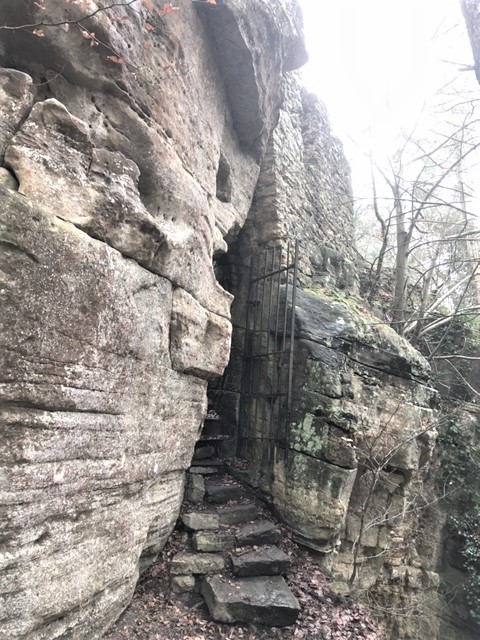
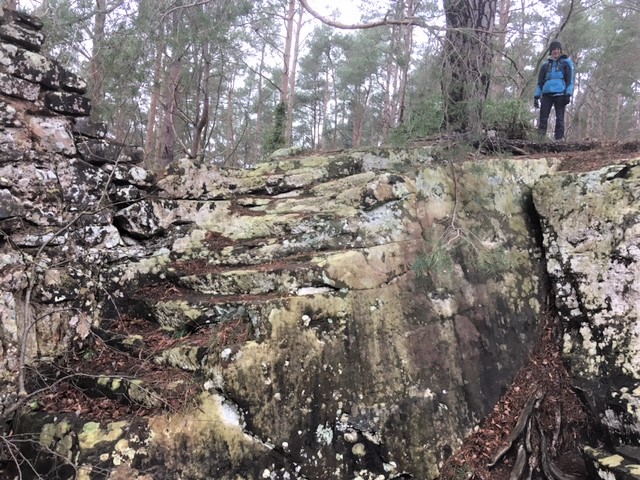
This sinister location, with sheer cliffs on almost every side and a narrow, menacing entrance, exudes a supernatural, eerie feel, a sensation amplified in my memory: it was here, just over six years ago, that I suffered a knee injury that has since led to two operations and a cruel, abrupt end to my beloved trailrunning.
I can still walk though, and walk on we did: down the steep boulder-strewn hill, then on past foaming waterfalls, through snow-flattened fields and under the winter-bare trees; on and on under the lifeless sky towards a new working year.
PRACTICAL INFO
- The ruins of Heringerbuerg castle can be found just north of the hamlet of Mullerthal itself; it is signposted from the Heringer Millen visitor centre.
- Entrance is free.
- The path is steep, rocky and inherently unsuitable for pushchairs or similar.
- If visiting with children, please exercise extreme caution around and inside the castle.

 Luxembourg Outdoors